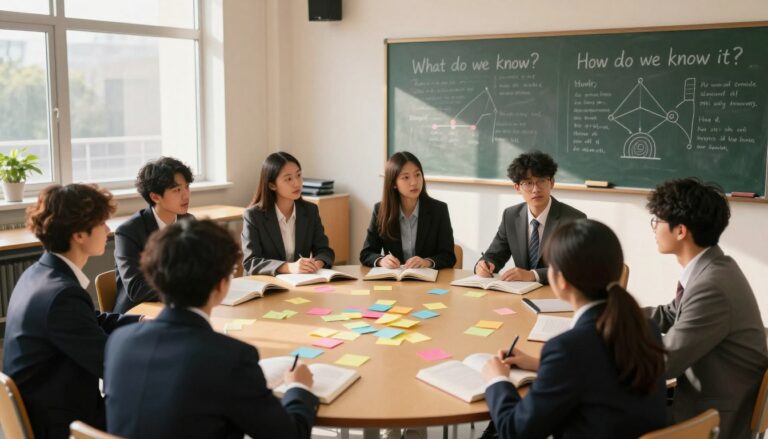
What Inquiry-Based Learning Looks Like in the Primary Years
Education is often viewed as a process of filling a vessel, yet the most profound growth occurs when we ignite a spark. Inquiry based learning represents a shift in this perspective, treating a child’s natural curiosity as the primary engine for discovery. By observing the world with intent, students transform from passive recipients into active participants in their own intellectual journey.
This child centred education model recognises that the primary years are critical for building foundational habits of mind. During this stage, observation and conversation are not mere distractions; they are essential tools for processing complex ideas. When we honour these instincts, we create an environment where children feel safe to explore the unknown.
Understanding how children learn requires us to look beyond traditional testing metrics. Through questioning in the classroom, educators and parents alike can witness the beauty of reflection and discovery. This approach to primary years learning ensures that knowledge is not just memorised, but deeply understood and internalised for the future.
Key Takeaways
- Curiosity serves as the fundamental catalyst for academic and personal development.
- Child centred education prioritises the unique pace at which each student matures.
- Active engagement allows pupils to realise their potential through meaningful exploration.
- Reflective practices help parents better understand the cognitive development of their children.
- Meaningful dialogue in the classroom fosters a deeper connection to the subject matter.
Inquiry based learning in the primary years
The landscape of primary education is evolving to better reflect how children naturally engage with the world. Rather than viewing students as passive recipients of information, modern educators are adopting an inquiry-based approach that places the child at the heart of the discovery process.
From teacher-led lessons to child-centred education
Traditional schooling often relies on a teacher-led model where information flows in one direction. In contrast, child-centred education encourages students to take an active role in forming ideas and testing possibilities.
This shift does not imply an absence of structure or guidance. Instead, teachers create purposeful boundaries that allow student-led learning to flourish within a safe and supportive environment. By setting clear goals, educators ensure that freedom of thought remains focused and productive.
How children learn through curiosity, exploration and discovery
Children possess an innate desire to understand the world around them. When we foster curiosity-driven learning, we tap into this natural motivation, turning every lesson into an opportunity for personal growth.
Exploration allows students to move beyond textbooks and engage with concepts through direct experience. This process typically involves several key stages that help children build a deeper understanding of their environment:
- Observing phenomena in the natural or social world.
- Formulating questions based on initial observations.
- Testing hypotheses through hands-on activities.
- Reflecting on findings to refine their original ideas.
Connecting inquiry to meaningful primary years learning
Effective classroom inquiry bridges the gap between abstract concepts and the reality of a child’s daily life. When learning is connected to practical problems, students find greater relevance in their studies.
Teachers facilitate this by designing experiences that encourage children to make connections between new knowledge and their existing understanding. This approach ensures that education is not merely about memorisation, but about developing the critical thinking skills necessary for lifelong success in the primary education sector.
Questioning in the classroom and the learning process
The heart of a vibrant classroom lies in the quality of the dialogue between teacher and student. When educators prioritise curiosity, they transform the standard primary school curriculum into a dynamic landscape of discovery.
Creating a classroom culture where children ask questions
A supportive environment is essential for children to feel comfortable sharing their thoughts. Teachers foster this by celebrating every inquiry, regardless of how simple or complex it may seem. This approach ensures that students view their own curiosity as a valuable tool for growth.
Using open-ended questions to deepen thinking
To build strong critical thinking skills, educators must move beyond queries that require only a single word. By using open-ended questions, teachers invite children to compare ideas, provide evidence, and revise their initial theories. This practice encourages students to look deeper into the subject matter rather than seeking a quick, definitive answer.
How teachers guide investigations without taking over
Effective teacher facilitation requires a delicate balance between guidance and autonomy. The goal is to support the child’s journey without imposing a rigid structure that stifles their natural desire to learn.
Listening, observing and responding to children’s ideas
Teachers act as active partners in the process of learning through exploration. By carefully observing how a child interacts with a task, an educator can offer timely prompts that extend the investigation. This responsive style ensures that the child remains the primary driver of their own educational experience.
Supporting different levels of confidence and language development
Every child enters the classroom with a unique set of communication skills and comfort levels. Some students may express their ideas through drawings or physical models before they feel ready to speak in front of their peers. Providing diverse ways to participate ensures that all children feel empowered to contribute to the collective inquiry.
Examples of inquiry-based learning across primary subjects
Inquiry is not limited to a single subject; it can be woven into every aspect of the school day. By connecting lessons to the real world, teachers make abstract concepts feel relevant and tangible.
Investigating local environments and everyday problems
Students can apply their critical thinking skills to solve challenges within their own communities. For instance, investigating why a local park needs more shade or how to reduce waste in the school canteen provides a practical context for scientific and social study. These projects demonstrate how open-ended questions can lead to meaningful, real-world solutions.
Using stories, objects and experiments as starting points
Teachers often use physical items or narratives to ignite the spark of inquiry. Below are common starting points used to facilitate learning through exploration:
- Historical objects: Analysing an old tool to guess its original purpose.
- Picture books: Discussing character motivations to explore complex social themes.
- Simple experiments: Testing how different materials react to water or heat.
- Nature walks: Collecting leaves or stones to categorise and compare findings.
Through these methods, teacher facilitation becomes a bridge between the child’s natural wonder and the formal primary school curriculum. This thoughtful approach ensures that education remains a lifelong pursuit of knowledge.
Conclusion
True education flourishes when schools prioritise deep understanding over simple memorisation. By valuing children’s questions, educators transform the classroom into a vibrant space for discovery.
This approach fosters independent thinking by allowing students to navigate complex ideas at their own pace. When pupils engage in collaborative learning, they gain diverse perspectives that enrich their personal growth.
Parents should seek institutions that champion experiential learning as a core pillar of the curriculum. Schools like The Heritage School or Rishi Valley School often demonstrate how subject-based inquiry creates lasting academic foundations.
Observe how a school responds to a child’s curiosity during your next visit. A genuine commitment to child-centred education ensures that every student feels heard, respected, and prepared for the challenges of the future.