AI in Education: What PISA 2025 Tells Us About Student Learning and Critical Thinking
If modern software can provide answers within seconds, are we still offering students enough chances to think for themselves? This question feels urgent today. Recent data from pisa 2025 highlights a sharp decline in reading and math performance across many nations over the last decade.
Simultaneously, digital tools have entered the classroom at a rapid pace. Statistics show that 46% of students now use automated chatbots weekly to assist with their studies. While these tools offer personalized support, we must ensure they strengthen reasoning rather than replace it.
It is important to note that current reports do not prove technology caused these academic drops. However, the trend forces us to rethink how AI in Education shapes the classroom. Our goal is to foster deep thought, ensuring that technology serves as a bridge to knowledge rather than a shortcut that bypasses the hard work of learning.
Key Takeaways
- PISA 2025 reveals a concerning downward trend in global student performance.
- Nearly half of all students now rely on chatbots for their weekly schoolwork.
- The rise of new technology creates a tension between convenience and deep cognitive development.
- We must prioritize ai and critical thinking to ensure students remain independent learners.
- Technology should act as a supportive tool rather than a replacement for human reasoning.
What PISA 2025 Reveals About Learning in the Age of AI
The latest pisa 2025 data offers a complex look at how students are performing in a world dominated by digital tools. As educators and policymakers review these findings, they are uncovering a landscape where traditional academic benchmarks are shifting rapidly.
The decline in OECD reading and mathematics performance
Recent reports indicate a notable downturn in student achievement across many OECD nations. Specifically, there is a measurable dip in both ai and reading skills and foundational proficiency in ai and mathematics learning.
These results are concerning for school systems worldwide. They suggest that the standard methods of instruction may be struggling to keep pace with the evolving needs of today’s learners.
What the 46% weekly AI chatbot figure tells us about students and AI
A striking detail from the study is that 46% of OECD students now use AI chatbots at least once a week for their schoolwork. This high level of engagement shows that technology has become a central pillar of the modern study routine.
Students are clearly turning to these tools to navigate complex assignments. However, the sheer frequency of this usage raises questions about how these platforms influence the way students process information.
Why PISA 2025 raises questions without proving AI caused the decline
While the data shows a clear trend, it is vital to avoid jumping to conclusions. Pisa 2025 does not provide definitive evidence that these digital tools are the direct cause of lower test scores.
Many factors contribute to student success, including post-pandemic recovery and changes in school funding. Attributing the decline solely to technology would be an oversimplification of a multifaceted issue.
Separating correlation from causation in debates about AI and academic performance
Discussions regarding ai and academic performance often confuse simple associations with direct cause-and-effect relationships. Just because students use AI and also show lower scores does not mean the software is responsible for the drop.
We must look deeper into how these tools are being utilized in the classroom. Rigorous analysis is required to understand if the technology is hindering or merely reflecting existing challenges in ai and reading skills.
Why changes in learning habits deserve closer attention
The shift in how students approach their work is perhaps the most important takeaway from pisa 2025. When students rely on chatbots for answers, they may be bypassing the critical thinking processes necessary for long-term growth in ai and mathematics learning.
Understanding these new habits is essential for future educational design. By focusing on how students interact with AI, we can better support their journey toward meaningful academic performance.
AI in Education Can Help Students Learn—but It Can Also Short-Circuit Thinking
The rapid rise of AI in education brings both incredible potential and significant risks to student development. While these tools offer unprecedented access to information, they also change the fundamental ways that learners engage with academic material.
How AI can personalize learning and explain difficult concepts instantly
Modern platforms allow for a highly tailored experience that meets individual needs. Students can receive instant feedback on complex topics, effectively turning a static textbook into an interactive tutor.
This ai impact on education means that a student struggling with a specific chemistry formula or a historical timeline can get an immediate, simplified explanation. By breaking down barriers to entry, technology helps keep learners motivated when they hit a wall.
The risk of receiving answers before developing reasoning skills
However, convenience often comes at a hidden cost. When students and ai interact, there is a strong temptation to use the technology as a shortcut rather than a support system.
If a learner receives a correct answer without working through the logic, they miss the chance to build essential cognitive pathways. True mastery requires the brain to grapple with information, not just consume it.
What students may lose when technology replaces productive struggle
Productive struggle is the process of working through a difficult problem until a breakthrough occurs. This effort is where deep learning happens, and it is exactly what can be lost when AI provides an instant solution.
When we remove the struggle, we inadvertently weaken the student’s ability to handle frustration. Building resilience is just as important as learning the subject matter itself.
Reading skills and the need to interpret, question, and evaluate ideas
In the realm of literacy, the goal is to teach students how to analyze texts deeply. If an AI summarizes a book or an article, the student may skip the vital work of questioning the author’s intent or evaluating the evidence provided.
Critical thinking depends on the ability to interpret nuance. Without this practice, students may struggle to form their own independent perspectives.
Mathematics learning and the difference between an answer and a solution
Mathematics is not merely about finding the right number at the end of a page. It is about understanding the logical steps required to reach that result.
A calculator or an AI can provide an answer in seconds, but it cannot teach the problem-solving process. Educators must ensure that students understand the “why” behind the math, rather than just relying on the “what.”
Why Critical Thinking Must Stay at the Center of AI-Supported Learning
To truly prepare students for the future, we must prioritize the connection between ai and critical thinking. While technology offers unprecedented access to information, it cannot replace the human capacity for deep analysis. Educators play a vital role in ensuring that digital tools serve as a bridge to understanding rather than a shortcut to completion.
Turning AI from an answer machine into a thinking partner
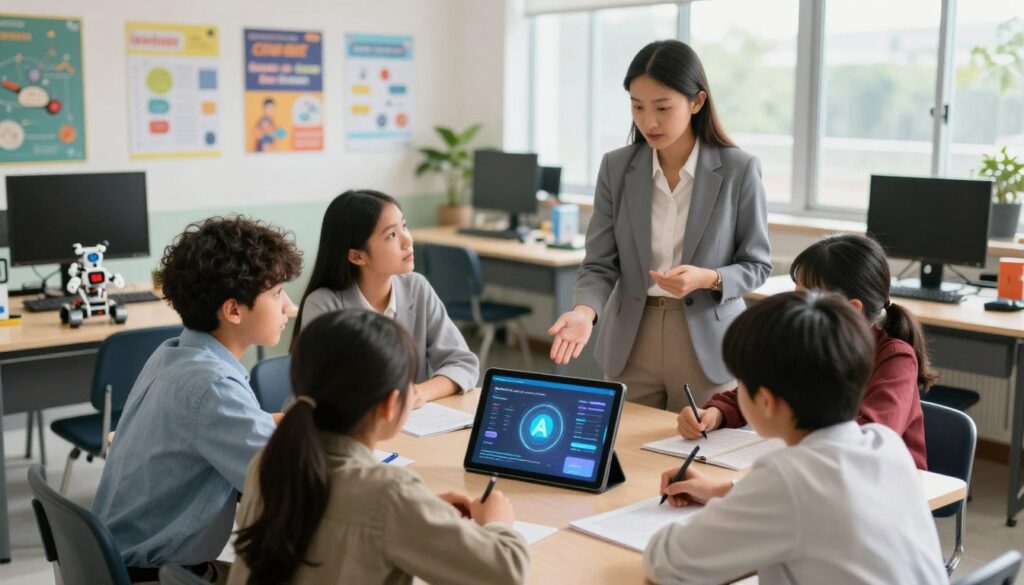
The goal of modern education is to shift the role of technology from a simple answer machine to a collaborative thinking partner. When students view AI as a peer for brainstorming, they remain in the driver’s seat of their own learning journey. This shift encourages them to actively engage with the material instead of passively consuming generated text.
Teaching students to verify information and challenge AI responses
Students must learn that AI models can occasionally produce inaccurate or biased information. By teaching them to verify facts through reliable sources, we build essential media literacy skills. Encouraging students to challenge AI responses fosters a healthy sense of skepticism that is necessary for academic success.
Using AI to support inquiry, creativity, and problem-solving
Integrating ai and critical thinking into the curriculum allows for more complex inquiry and creative exploration. Rather than asking for a final essay, teachers can prompt students to use AI to generate multiple perspectives on a historical event. This approach forces students to synthesize information and develop their own unique arguments.
Questions students should ask before trusting an AI-generated response
Before accepting any output, students should pause and evaluate the content critically. They should ask themselves: “What evidence supports this claim?” and “Are there alternative viewpoints that the AI ignored?” These simple questions help students maintain intellectual independence in a digital world.
Classroom activities that require independent reasoning after AI assistance
Teachers can design assignments that require students to demonstrate their reasoning after using AI tools. For example, a student might use AI to outline a science project but must then write a reflection explaining why they chose specific methods. This ensures that the final product reflects the student’s own independent reasoning and hard work.
How Schools Can Build AI Literacy Without Letting Technology Think for Students
Developing ai literacy in schools is the most effective way to ensure students remain the masters of their own intellectual growth. Rather than banning tools, educators must create a culture where technology serves as a bridge to deeper understanding. This approach ensures that AI in Education acts as a catalyst for curiosity rather than a shortcut for cognitive effort.
Defining responsible AI use for students and teachers
Responsible use begins with clear, transparent guidelines that treat AI as a collaborative tool. Students should understand that while a chatbot can generate text, it cannot replicate the nuance of human experience or original insight. Teachers must set boundaries that prioritize academic integrity and personal accountability.
Designing assignments that make thinking visible
To prevent technology from replacing critical thought, assignments must require students to show their work. Educators can design tasks that demand documented problem-solving processes rather than just a final, polished answer. By focusing on the journey of discovery, schools can ensure that students are actually learning the material.
Rethinking assessment around reasoning, application, and creativity
Traditional testing methods often struggle to measure skills in an era of generative models. Assessment should shift toward reasoning and application, where students must apply concepts to novel, real-world scenarios. This makes it harder for AI to provide a simple, pre-packaged solution.
Assessing explanations, revisions, and problem-solving processes
Grading should prioritize the evolution of an idea over the final product. When students submit multiple drafts or explain their reasoning behind a specific choice, they demonstrate true mastery. This process forces them to engage with the content deeply, ensuring they understand the “why” behind every answer.
Balancing AI-assisted work with independent demonstrations of learning
It is vital to maintain a balance between digital assistance and independent work. Teachers might allow AI for brainstorming or research, but require in-class, handwritten, or oral demonstrations of core concepts. This hybrid approach verifies that students have internalized the knowledge they are using.
Helping educators guide students through the benefits and limits of AI
Educators play a crucial role in helping students navigate the complexities of modern tools. By modeling how to verify information and challenge AI responses, teachers empower students to become skeptical and thoughtful consumers of technology. Promoting AI in Education requires a commitment to teaching students how to use these systems as partners in their own intellectual development.
Conclusion
The PISA 2025 results spark a vital conversation about how we teach the next generation. While these scores highlight a dip in performance, they do not blame technology for every challenge. We must focus on how students interact with tools like ChatGPT or Claude to ensure they remain active thinkers.
The future of education depends on our ability to balance innovation with core cognitive skills. We want students to use AI as a partner for discovery rather than a shortcut for answers. This shift requires schools to prioritize assignments that demand original reasoning and creative problem-solving.
True learning happens when students engage in the productive struggle of finding solutions. By fostering AI literacy, educators can guide learners to verify facts and challenge machine-generated outputs. This approach protects the human capacity for deep thought while embracing modern advancements.
We invite you to consider how your classroom or home environment supports independent inquiry. Shaping the future of education is a shared responsibility that starts with asking better questions. Let us commit to a path where technology serves the mind instead of replacing the essential work of thinking.